The story
THE BEST OF YOUTH, PASOLINI TRAIL IN IDRIJAPier Paolo Pasolini is considered a versatile artist: he was a writer, poet, playwright, film director, critic, journalist, and philosopher. His novels The Dream of Something, Petrolio, A Violent Life, Theorem, and Amado Mio have been translated into Slovenian. The latter contains an excerpt with Pasolini’s memory-dream reflections on Idrija. The Magazin building, which was built in 1769 as a mine granary for storing grain and other foodstuffs and is one of the oldest Baroque buildings in Slovenia, today houses the City Library and Reading Room, the Magazin Gallery, and the War Museum.¹
Pasolini’s film oeuvre includes, among others, the films Accattone, Mamma Roma, The Gospel According to St. Matthew, The Hawks and the Sparrows, Oedipus Rex, Theorem, Pigsty, Medea, The Decameron, The Canterbury Tales, Arabian Nights, and Salò, or the 120 Days of Sodom. The Idrija Film (Mine) Theater, as the oldest preserved masonry theater building in Slovenia, is one of the most important monuments of the town of Idrija and the state of Slovenia. Based on the archival documentation discovered so far, we cannot precisely determine the time and circumstances of the creation of the theater on the so-called Old Square, today’s St. Achacius Square. Most authors of articles about the mine theater mention that the building was constructed in 1769 or 1770 – after the construction of the new granary was completed.²
In 1995, Majda Širca directed a documentary film about Pier Paolo Pasolini.
¹ Mihael Arko: History of Idrija (p. 112): »Court Commissioner von Hohengarten made a plan for a new warehouse in 1768. It would cost only 9865 florins. The following year, they indeed began to build a gigantic building, which served its purpose very well for a full 140 years until the abolition of the grain supply. Miners’ wives and children went to the »magazine« for their »rations«. Now soldiers live in it.«
² Source: Nataša Jurgec Gurnick: Conservation Plan, Idrija – Mine Theater (EŠD 186), Ptuj, April 2013.
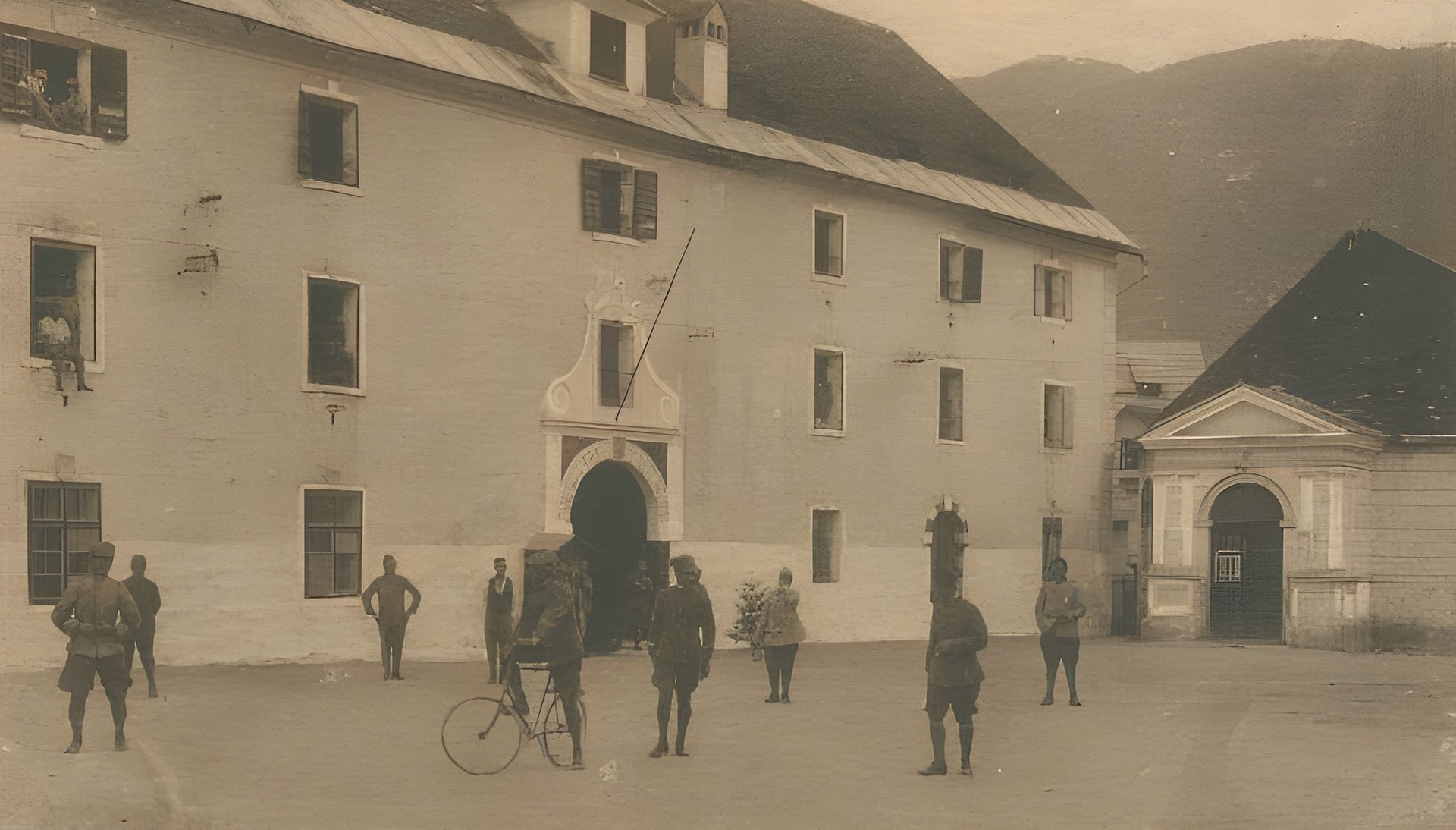
Pasolini was deeply connected with his mother Susanna throughout his life, but he was also marked by the figure of his father-soldier. After arriving in Idrija, the Italian army settled right in the Magazin. Pasolini's father, Carlo, probably also served here. You will discover where the military barracks operated later in Idrija at the next point.— »Invitation«
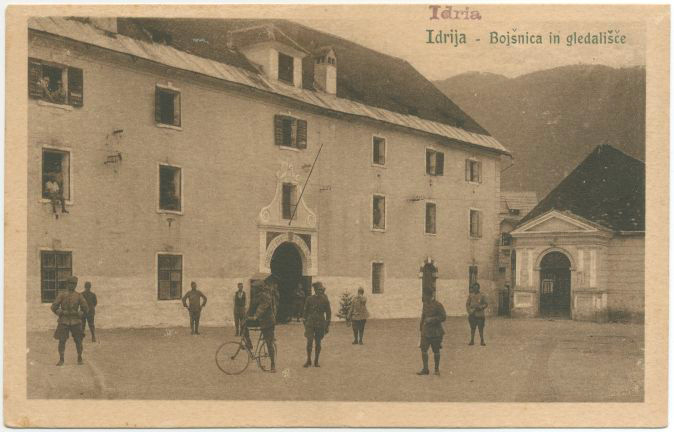
Stavba Magazina in Filmskega gledališča pred letom 1919. Vir: ZAL, Enota v Idriji, SI_ZAL_IDR/0218, zbirka razglednic in fotografij, Idrija, TE 1, PE 128.
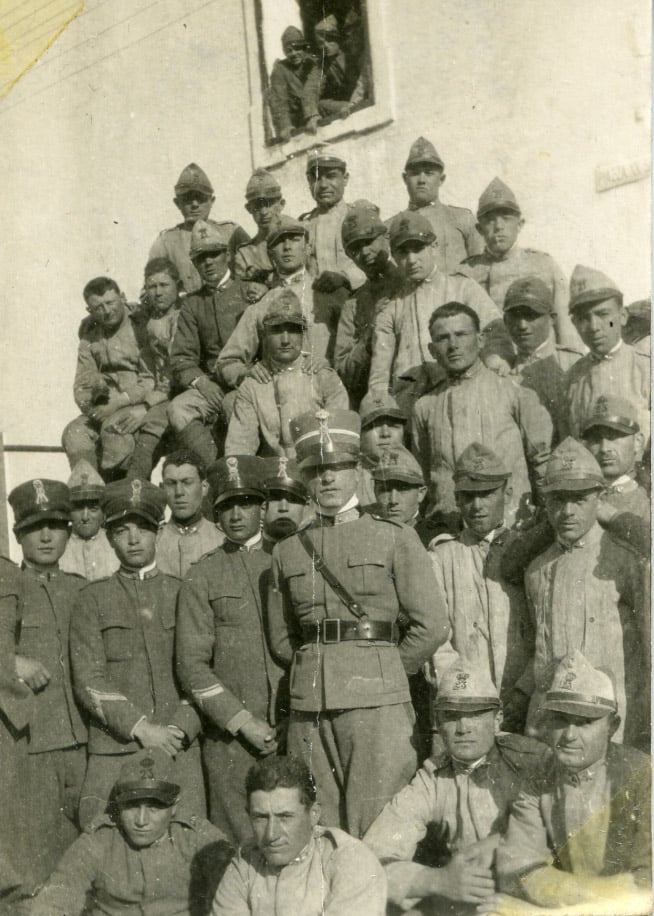
Italian soldiers in front of the barracks – the old Magazin building, during the Italian occupation. Source: photo archive of the Idrija Municipal Museum.
I was in Idrija: my father, mother, and I found ourselves alone in the hallway. We missed Guido terribly. With the joy of former days (when I was still a child), I was getting ready for bed in my old room. Suddenly I wanted to go out to see the huge square with chestnuts on the hill in front of the house. I couldn't remember where the door was; I found it through a mechanical effort of memory. I fell to my knees: through the open door, I saw a park I hadn't seen for fifteen years. But what a change! A fabulous, indescribable scent flared in my chest so that I shouted with joy; the trees, like a visible image of this scent, looked wonderful in their perfect, calm greenery, full of pink flowers in clusters and braids that could adorn paradise.— EXCERPT FROM PASOLINI'S NOVEL AMADO MIO - Translated by Milan Štefe
I knew I was dreaming. I still think of that intoxicating scent, of the inexpressible perfection of those branches and rose hedges. So I was in Idrija; in the house where I lived when I was nine. Did memory fill it with such joy?
A perverse little boy with pure jewels
of Europe in his sex,
dead from shyness, I entered
the museum guarded by Adults.
I loved a statue, more naked than love:
where I was flesh, this statue was
ivory. How should I put on it
the wicked trousers that wrap
around my innocent hips? I keep trying,
an eternal boy, to embrace with my gaze
the shining marble, until I go blind.
I gave my faithful and formless zeal
to that pre-existent Form, ignited
by my love, cruelly intact.
I loved too much! My hope
was boyish, without irony:
I did not allow the slightest comfort
to my dreams, the slightest smile:
but there were Origins. And my unreturned
kisses had no power
to tear me away from certain death.
And the path of death was open to me.
You, terrible statue, are death
in my past, I no longer want to want you,
I want my naked silence,
the silence of a boy whom a certain Europe
without statues ignited with the morning dawn,
the silence of a boy who in dialect flies
on his virgin heart without a world.
I deny all that I confessed
to move you, I deny my sin
and my burning conscience: I too will be ivory,
the ivory of a boy unknown to God.
Once again I walk my path – backwards:
how gentle it is, if you are not there,
the Po Valley landscape without the shadow of illusions!
The Livenza spreads its roses,
green, Idrija mirrors the scentless
violets, the sky without blue stares
at the Casarsian trenches without childhood.
And the knives clink at the New Year’s
dinners and gleam happily.
The May bug groans without response
in the senses of the hiding boy.
Without your alabaster threat
I will again live the passion for my mother,
the obedience to my lap, which takes possession
of tenderness and noble shames…
Again, without the slightest shadow, I will experience astonishment
at the clock, mice, slingshots,
comrades, the church, the small square.
I will be a Narcissus-flower that mirrors itself,
loving without love, with ears
confused by voices that love without words
invents for the flower.
But you, ivory hendecasyllable,
a madrigal for a viola or a statue
of poetics, among enamels and the water
of Arcadia, eternally adult,
you love only joy… and purity.
You don’t want the sins – or the regrets –
of boys! And what? Can an angel pray
in the Parthenon? Or a martyr
become a lily? Love is ultimately a drought.
But I will, I will be guilty of having loved you,
Authority, I the Only One, I the Marked One.
No, I have no mother, it has no sex,
I killed my father with silence,
I love my madness made of water and absence,
I love my yellow boyish face,
the innocence I feign, and the hysteria
I hide in the heresy and schism
of my jargon, I love my guilt,
which was, when I entered the museum
of adults, a crease in the trousers, the cries
of a shy heart: and you reject
what I love you for, and you do not change me.
Translated by Miklavž Komelj


