
The story
BETWEEN ART AND NATURE, PASOLINI TRAIL IN IDRIJAWe named this point after the patron saint of miners, St. Barbara, because the entrance to Barbara’s Shaft was in the immediate vicinity (at the edge of today’s Spar center parking lot). From here, a view opens up of the Church of St. Anthony of Padua and the Calvary or the Way of the Cross, which is also one of the important elements in Pasolini’s film The Gospel According to St. Matthew, and to the left of it, the mighty building of the former military barracks. Between 1928 and 1932, the Kingdom of Italy built a mighty defensive military complex, Caserma di fanteria Costantino Brighenti, on the hill above Idrija, which opened on April 5, 1933. During that period, Italy wanted to expand towards the east, so it built a large and well-fortified military complex to defend the border, which was also known as one of the most beautiful in the Kingdom of Italy at the time. The barracks were considered the largest Italian »caserma« along the then Italian eastern border with old Yugoslavia, as it was intended to accommodate as many as 4,000 Italian soldiers. The construction of the building was an expensive and demanding project due to its remote location, as the entire area around the construction site was uninhabited, and it was also necessary to build a road and other infrastructural connections. Almost seven years passed from the design to the actual opening.
Today (and since 1957), the Idrija Psychiatric Hospital has its premises there. According to Srečko Logar, our republic gained a wonderful and useful home with this institution, and Idrija gained a philanthropic institution of the greatest importance in all respects in the place of a desolate and useless military barracks.¹
¹ Source: Zbornik 60 let »bolnišnice na griču« (2018), pp. 20-21
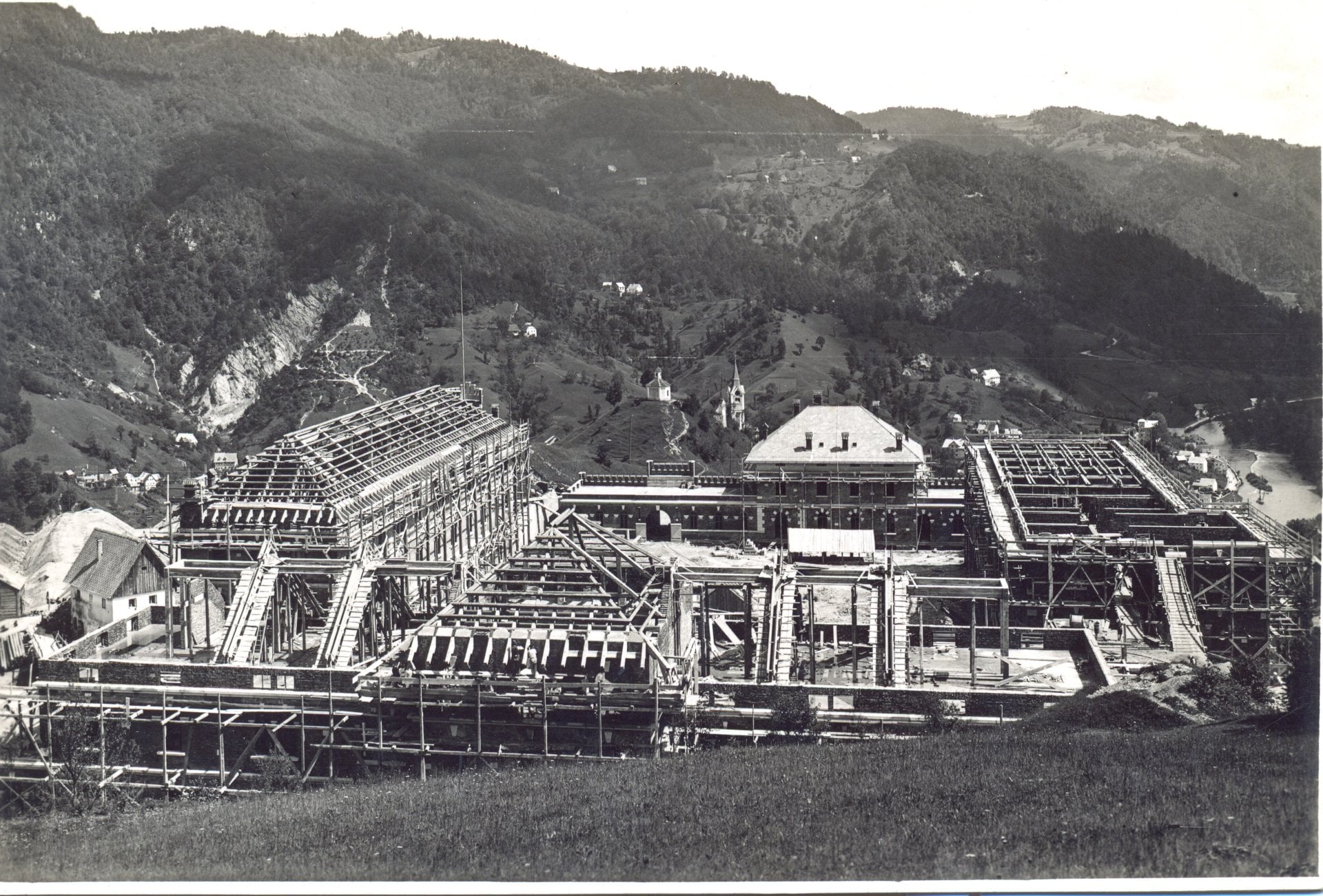
Construction of the former barracks building. Source: Slavko Moravec Military Museum.

Former military barracks, today the Idrija Psychiatric Hospital. Source: Slavko Moravec Military Museum.

Pier Paolo Pasolini's father, Carlo Alberto Pasolini, in Idrija (in the photograph, second from left). Source: photo archive of the Centro Studi Pier Paolo Pasolini, Casarsa.

Pier Paolo Pasolini's father, Carlo Alberto Pasolini, in Idrija (in the photograph, fourth from right in the front row). Source: photo archive of the Centro Studi Pier Paolo Pasolini, Casarsa.
The Idrijca river and water in general is one of the important motifs or elements in Pasolini's creativity. This is also confirmed by the next »water« point.— »Invitation«


